Solo travel has its own logic. You move at your own speed. You linger where you want and leave when you’re ready. You eat alone, which means you actually taste the food. You talk to strangers more than you would if you had someone to talk to already. The best solo destinations are the ones that reward this kind of open, unhurried engagement rather than making you feel like you’re missing something by not having a group around you.
Punta del Este, on a narrow peninsula jutting into the Atlantic from Uruguay’s southern coast, is that kind of destination. It has a reputation as the Hamptons of South America, a summer playground for Argentine and Brazilian money, and that reputation is not entirely wrong. But underneath the glamour is a small, walkable city with serious art, excellent food, a street environment that feels calm and manageable, and a surrounding coastline that changes character completely depending on which direction you walk. For solo travelers who want South America without the logistical stress of its larger cities, Punta del Este makes a strong case.
Here are eight reasons it works so well when you’re traveling on your own.
1. The Peninsula Is Small Enough to Know on Foot in a Day
The urban core of Punta del Este sits on a narrow finger of land roughly three kilometres long and one kilometre wide. The tip of the peninsula holds the port and the old lighthouse. The eastern shore faces the open Atlantic. The western shore looks back toward Maldonado Bay and the mainland. Walking from one end to the other, with stops for coffee and to look at things, takes about two hours at a relaxed pace.
This scale is ideal for solo travel. You don’t need to plan routes or worry about getting lost. The streets are a grid. The landmark buildings are visible from almost anywhere on the peninsula. The beach is always within a few minutes’ walk in either direction. For solo travelers who find large cities exhausting to navigate alone, this kind of contained, legible environment provides freedom rather than anxiety. You know where you are. You can decide where to go next based on what you feel like doing rather than where the map says you are.
2. Uruguay Is Consistently One of South America’s Safest Countries
Uruguay ranks at or near the top of regional safety indices year after year and is regularly cited alongside Chile as the most stable and secure destination in South America for independent travelers. Punta del Este benefits from this national baseline and adds its own layer: the city’s small, well-monitored peninsula and its history as a destination for high-net-worth visitors has produced a street environment that is noticeably calmer than comparably sized cities elsewhere in the region.
For solo travelers, and in particular for solo travelers who are newer to independent travel, this safety profile changes the fundamental calculation of what’s enjoyable. When you’re not spending mental energy on threat assessment, you can spend it on the actual experience of being somewhere. The restaurants you walk past after dinner, the beach you decide to visit at dawn, the bar you end up in because it looked interesting from the street: all of these are more available when the baseline anxiety of solo urban navigation is low. As our lecture on how to start traveling on your own discusses, one of the most important early decisions a new solo traveler makes is choosing a destination where the environment works with them rather than against them. Uruguay and Punta del Este both qualify.
3. The Art Scene Is World-Class and Walkable
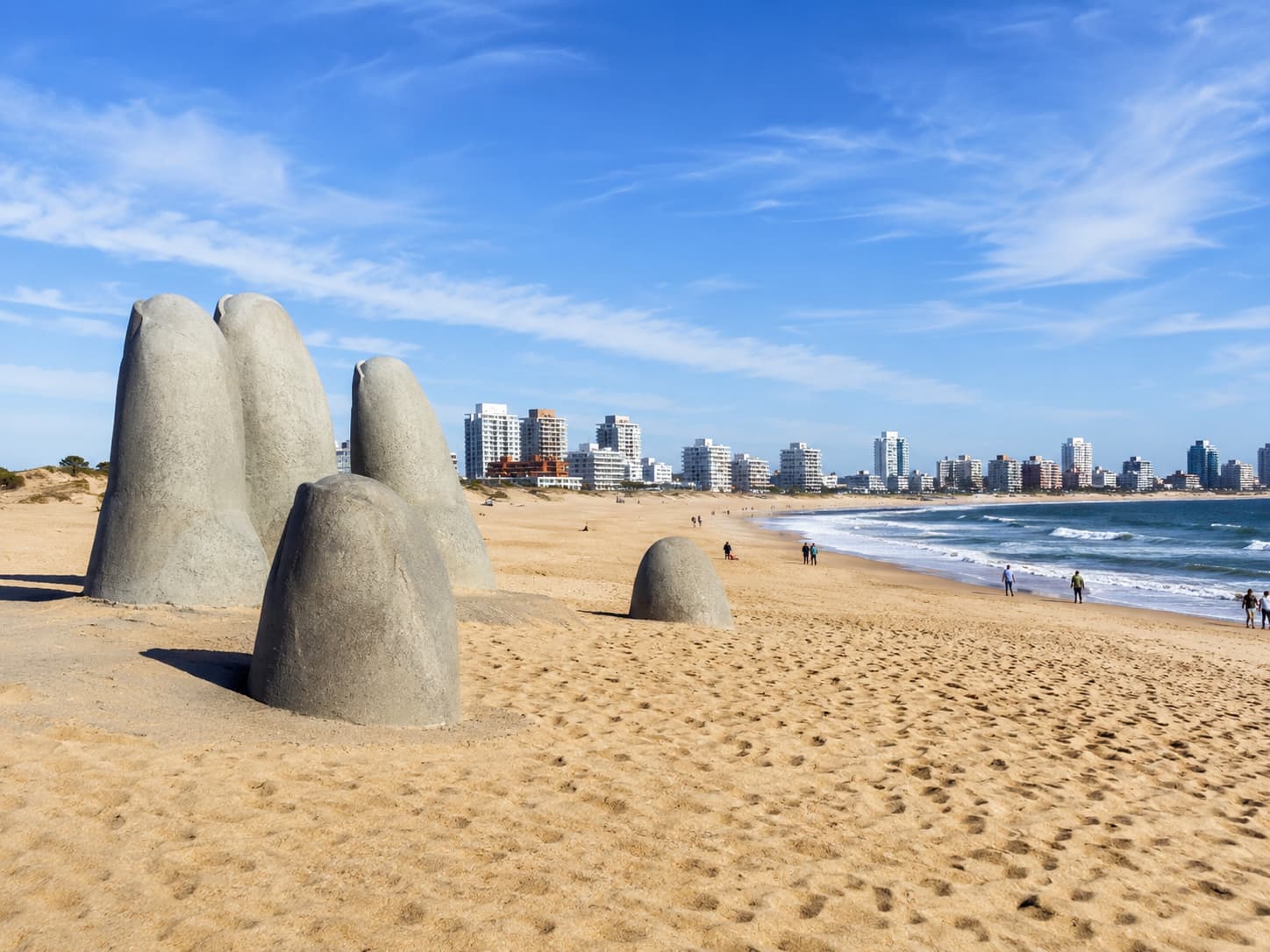
Punta del Este has attracted artists and collectors since the mid-20th century, and the legacy of that relationship is visible across the city in ways that reward slow, solo exploration. The most famous piece is La Mano, the giant hand sculpture by Chilean artist Mario Irarrázabal that emerges from the sand at Playa Brava with five fingers reaching skyward. It has become the city’s defining image, but it is only the starting point of an outdoor sculpture and public art trail that runs across the peninsula and into the surrounding suburbs.
The Museo Ralli, a private museum holding one of the largest collections of contemporary Latin American art in the region, is free to enter and located in a residential area a short walk from the beach. The Casapueblo, designed by Uruguayan artist Carlos Páez Vilaró over several decades of continuous construction on a clifftop at Punta Ballena 12 kilometres west of the city, is one of the more unusual architectural experiences in South America: a whitewashed building that looks like it grew from the rock rather than being built on it, now functioning as a hotel and museum. Solo travelers who budget time for these sites rather than treating the city as purely a beach destination come away with a significantly richer experience.
4. The Food Scene Rewards Eating Alone
Eating alone in some cities is a logistical challenge, a question of where you can sit without feeling unwelcome at a table for two. In Punta del Este, it is not a problem. The restaurant culture here is relaxed and unhurried, bar seating is common and not considered a second-tier option, and the quality of the food, seafood and grilled meat from Uruguay’s famously well-raised cattle above all, is high enough that the meal itself holds your attention without requiring company to fill the gaps.
The chivito, Uruguay’s national sandwich of beef, ham, egg, cheese, and various additions stacked improbably on a bun, is one of those dishes that solo travelers tend to discover at a counter somewhere and immediately add to the mental list of things they will miss when they leave. The local wine from Uruguay’s Tannat grape, produced in the Canelones and Maldonado wine regions within a short drive of the city, is worth seeking out by the glass in the restaurants near the port, where the wine list reflects regional production rather than international defaults.
5. The Two Beaches Have Completely Different Characters
Punta del Este has two main beaches, separated by the width of the peninsula. Playa Mansa on the western bay-facing shore is calm, flat, and sheltered: family groups, paddleboats, warm shallow water that stays gentle most of the year. Playa Brava on the eastern Atlantic-facing shore is exposed, with stronger currents, heavier surf, and a different kind of crowd: surfers, kiteboarders, people walking along the tideline in the wind.
For a solo traveler spending several days in the city, alternating between the two beaches produces days that feel nothing like each other. The Mansa side in the morning for a swim, the Brava side in the afternoon for the light and the wind and the waves you don’t swim in: this is a rhythm that works well when you’re deciding for yourself what each day should feel like. The beach further east toward José Ignacio, a small village about an hour’s drive along the Atlantic coast, is another kind of experience again: quieter, wilder, with a lighthouse and a small fishing community that operates largely outside the Punta del Este tourist circuit.
6. Guided Tours Open Up the Surrounding Region That Solo Navigation Misses
Punta del Este is a good base for a wider region that includes wine country, colonial towns, natural reserves, and coastline that extends well beyond what’s reachable on foot. The Laguna Garzón, a coastal lagoon connected to the Atlantic by a narrow channel about 40 kilometres east, has a circular bridge designed by Uruguayan architect Rafael Viñoly that is worth the drive alone. The town of Colonia del Sacramento, a UNESCO World Heritage Site of Portuguese and Spanish colonial architecture on the Río de la Plata, is reachable in a few hours.
For solo travelers who want to cover this wider range without the logistics of renting a car and navigating unfamiliar roads alone, operators like Punta del Este Tours offer structured day and half-day experiences across the key regional destinations: winery visits, coastal drives, historical town tours, and boat excursions on the bay. Having that infrastructure removes the planning overhead that can make independent regional exploration more draining than rewarding when you’re managing everything yourself.
7. The Off-Season Is When the City Shows Its Real Character
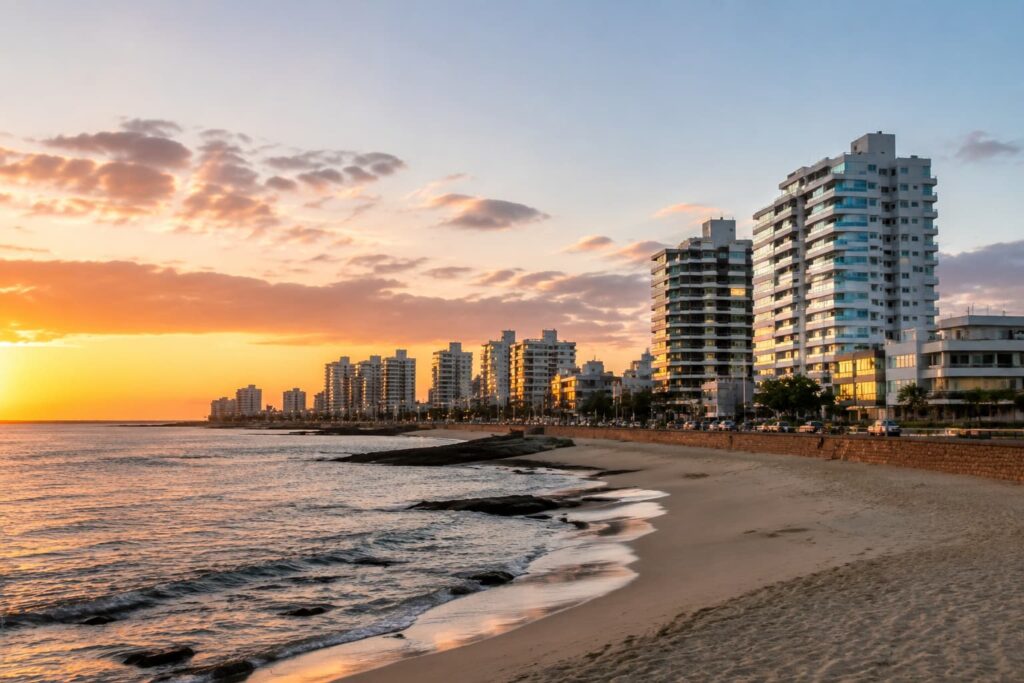
Punta del Este in January and February is crowded. The peninsula’s population swells by tens of thousands as Argentine and Brazilian summer visitors arrive, restaurants run waiting lists, and the beaches are full from morning until sunset. It is a specific kind of experience: noisy, social, visually abundant, and tiring if you were hoping for solitude.
March through November is a different city. The crowds thin, the prices drop, and the restaurants, galleries, and streets operate at a pace that is much more conducive to the kind of slow, observant travel that solo visitors tend to prefer. The sea is still warm enough to swim through April. The light in autumn is low and good. The cafes along the port have tables available without a wait. The Casapueblo’s sunset ceremony, which the artist Carlos Páez Vilaró designed and which continues daily year-round, is considerably more moving when you’re watching it with twenty people rather than two hundred.
8. Solo Travel Works Better Here Than in Most South American Cities
Many South American cities are structured around group travel in ways that are not always obvious until you arrive alone. The large-table restaurant culture, the club nights that don’t get interesting until 2am and require a group to navigate safely, the day trips that make more sense with a car full of people splitting the cost: these are features of regional travel culture that work against solo visitors at a basic logistical level.
Punta del Este is an exception. The city’s scale makes individual movement natural. The art and beach culture are solo-compatible by default. The café culture around the port gives solo visitors a default social environment without requiring effort to access it. The general safety profile means evenings are available to solo travelers in a way they are not in comparable-sized cities in Argentina or Brazil. For travelers who are building their confidence with independent South American travel, which our piece on solo travel safety and confidence addresses at length, Punta del Este is one of the more forgiving places on the continent to start.
A Final Thought
The best solo destinations are not the most dramatic or the most remote. They are the ones where the environment cooperates with what solo travel actually requires: safety, legibility, enough social infrastructure to find company when you want it and enough space to be alone when you don’t, and the kind of beauty and interest that rewards paying attention on your own terms.
Punta del Este has all of those things. It also has La Mano rising from the beach at Playa Brava, which is one of the stranger and more memorable things you will walk past on a morning run anywhere in South America.
Go in the shoulder season. Book somewhere near the port. Give it more than two days.